.png)
From wallstreet to Beijing: the new AI investment shift
- Team Kautilya

- Jan 11
- 3 min read
SYNOPSIS
AI investing is no longer only about Wall Street. While US tech giants led early AI growth, high valuations in 2024 - 25 pushed investors to look elsewhere. China is emerging strongly due to government support, real world AI applications, and relatively cheaper valuations. However, geopolitical and regulatory risks remain.
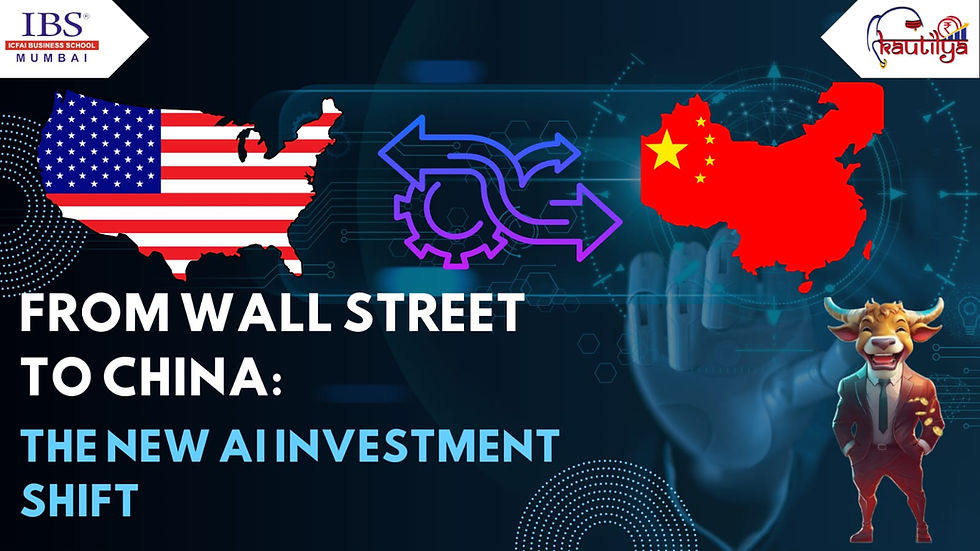
Artificial Intelligence has become one of the most important aspects of global investments in recent times. For years, Wall Street was leading the story of AI, as US tech giants invested largely in innovation. However, a noticeable shift is taking place. Most of the investors are now looking beyond Wall Street and focusing on Beijing, signaling a major shift in where the investments are going in AI.
Wall Street was dominating AI on strong foundations. Companies like Microsoft, Google, and OpenAI led breakthroughs in machine learning, cloud computing, and generative AI. These companies got benefited from capital markets and strong investors confidence. By 2024-2025, several leading AI firms were trading at price, multiplying far above the past averages. As a result, US tech stocks experienced a rapid growth and AI became identical to American innovation, nevertheless, this rapid growth also raised concerns about the overvaluation of the stocks. This is because many AI- related stocks began to trade at an extremely high rate.
As a result, investors started reallocating their capital away from US AI stocks. In 2025, global investors invested $3.7 billion in Chinese AI related equities within six months, growing confidence outside Wall Street. Rising interest rates and higher profits have encouraged investors to diversify their portfolios. Instead of concentrating only on the US tech giants, investors are now exploring AI companies too.
China has emerged to be a strong contender in the changing environment. Beijing has made AI as a national priority supporting it through policies, initiatives, fundings and a strategic planning. Government linked AI investment is expected to reach around $55 billion by the late-2020s. These days, Chinese tech companies and startups are aiming to develop cost efficient AI models, focusing on real life applications like manufacturing, finance, and healthcare. China enjoys the advantage in training and scaling of AI technologies due to its massive population and access to large volumes of data. As compared to the US companies, many Chinese AI companies are still undervalued, creating an opportunity for the investors to seek long- term growth at reasonable prices.
Geopolitics always plays a crucial role in shaping investment flows. The US- China tech rivalry has transformed AI from commercial opportunity to long- term investment. However, investing in AI has a large risk for the investors. The key challenges like regulatory uncertainty, governance concerns, and ongoing political tensions remain the same. The foreign investors must go through the policy changes, transparency standards, and market volatility before investing their capital.
In conclusion, investing in AI is no longer limited to Wall Street but Beijing has also become one of the serious players in the global AI race, attracting the investor’s interests. While US continues to lead the innovation, China offers support along with the long- term growth potential. The future of AI is going to be transformational and globalized soon with both Wall Street and Beijing facing the technological and economic transformation.



Comments